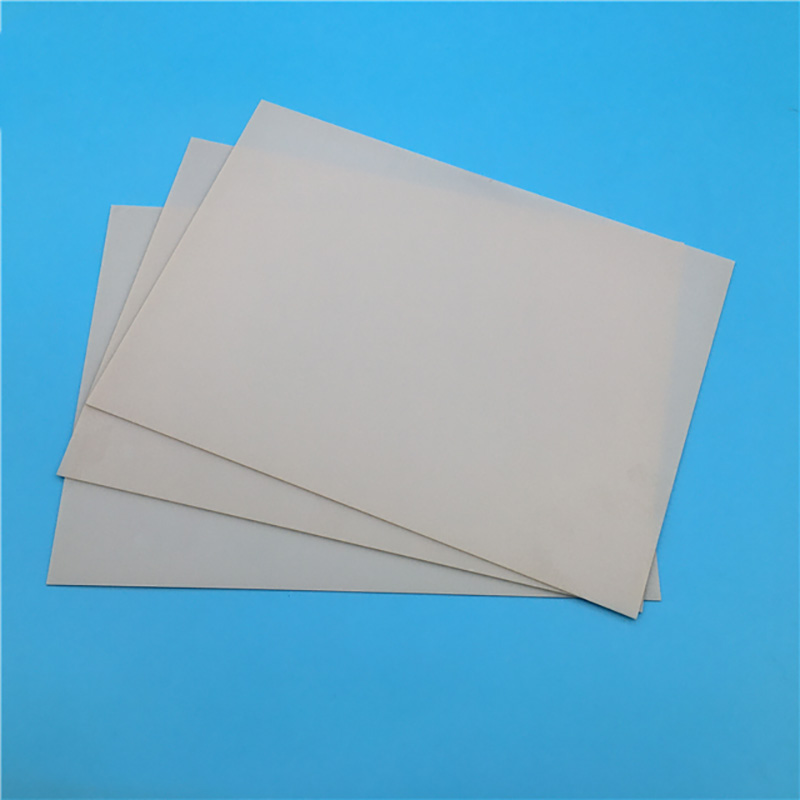
Aluminum Nitride and Aluminum Nitride
Aluminum Nitride (AlN) is an ideal material to use in thermal applications. With high thermal conductivity, insulation properties and low coefficient of thermal expansion rates, AlN makes an attractive material choice that is safe alternative to Beryllium Oxide in semiconductor industry applications and easy to machine.
AlN can be machined in its green, biscuit, or fully sintered state for machining. However, fully sintered material requires extra time and skill in order to meet strict tolerances.
High thermal conductivity
Aluminium nitride’s excellent thermal conductivity makes it an excellent material for heat dissipation in electronic devices. Modern electronics produce large amounts of heat which must be dissipated quickly; aluminum nitride’s insulation properties help ensure overheating doesn’t occur, increasing reliability over time and prolonging component lifetime.
AlN has a density of 3.26 g/cm3, as well as an extremely high thermal conductivity of 170 W/(m-K), more than five times greater than that of alumina and nearing beryllia in terms of thermal conductivity. Unfortunately, AlN’s thermal conductivity can be reduced by oxygen impurities present in starting powders during sintering processes, though.
To improve thermal conductivity, the powder is mixed with sintering aids like CaO and Y2O3. Particles are then ground down to an ultrafine particle size distribution using a high-performance mill, enabling more tightly packed ceramic structures. This creates dense ceramic structures with excellent thermal insulation properties.
Aluminium nitride’s superior thermal and electrical insulation make it an excellent material for MEMS applications, including high frequency filters, energy harvesters and ultrasonic transducers. Furthermore, its wide band gap, compatibility with complementary metal oxide semiconductor (CMOS) technology and superior piezoelectric properties make this material suitable for many MEMS devices such as high frequency filters, energy harvesters and ultrasonic transducers. Furthermore, its mechanical properties allow it to be easily formed.
High electrical insulation
Aluminum nitride is a non-toxic ceramic material with excellent thermal conductivity, electrical insulation and low expansion properties – perfect for large-scale integrated circuit heat dissipation substrates and packaging applications. Additionally, this non-toxic material resists plasma erosion and chemical corrosion and is easily metalized, plated, brazed or brazed into place – plus its Al-N bonds provide exceptional resistance against corrosion, oxidation and fatigue resistance.
Ceramic has higher thermal conductivity and density than its alumina and beryllia counterparts, while boasting lower expansion coefficient than alumina for higher-temperature applications and superior plasma erosion resistance than most metals.
Aluminum nitride stands out as an attractive option in electronic applications due to its low thermal expansion and excellent electrical insulation properties, providing an alternative choice to beryllia in certain instances. Its lower density and electrical properties make aluminum nitride an especially suitable material for components requiring tight tolerances such as radio-frequency components.
Aluminum Nitride (AlN) is an attractive material for microelectromechanical system (MEMS) applications such as high-frequency filters and energy harvesters, featuring wide band gaps and piezoelectric properties compatible with complementary metal oxide semiconductor (CMOS) technology. Furthermore, AlN can be easily machined due to its low melting point. However, its shrinkage rates after sintering can prove challenging in maintaining tight tolerances with this material.
High mechanical strength
Aluminum nitride boasts exceptional mechanical strength, making it an excellent material for creating ceramic substrates for semiconductors. As one of the strongest ceramic materials currently used – with higher bending strength than both silicon carbide and aluminum oxide – and due to its excellent thermal conductivity properties it also offers excellent electrical insulating properties.
Aluminum nitride’s unique combination of properties make it ideal for power and microelectronics applications, and often serves as an alternative to beryllium oxide in electronics due to the health risks associated with handling BeO. Furthermore, aluminum nitride boasts much lower coefficient of thermal expansion compared to both alumina and beryllium oxide, making it a good fit for applications requiring low-temperature operation.
Recent advances in power semiconductor technology have created an increased need for alternative materials that can efficiently dissipate heat. Traditional ceramic substrate materials, including aluminum oxide (Al2O3) and silicon nitride (Si3N4), have proven insufficient in this regard, so AlGalN has emerged as a potential candidate due to its superior thermal conductivity.
Unfortunately, making the switch from Alumina to AlGalN requires extensive machining in a nitrogen atmosphere with long lead times for some manufacturers. To help overcome this obstacle, some companies have developed machinable AlN products manufactured as billets that can be machined without using diamond tools and more cost-effective than pure AlN. These machinable products can also be obtained from multiple suppliers which reduce lead times even further.
High oxidation resistance
Aluminum Nitride (AlN) is a solid nitride of aluminium with high thermal conductivity and excellent electrical insulation properties. Additionally, AlN’s resistance to oxidation, abrasion and corrosion protect it against damage from aluminium melting as well as gallium arsenide corrosion; furthermore it is non-toxic.
Atmospheric plastic is an ideal material for applications in harsh environments as it can withstand high temperatures and chemical abrasion, making it the perfect material to withstand vibration and stress while remaining electrically conductive and UV radiation resistant. Furthermore, high voltages can also be tolerated while its mechanical strength makes it suitable to resist vibration and stress as well. Lastly, electrical conductivity and UV radiation resistance make this plastic an excellent material.
This material can be machined using standard machining tools, offering excellent mechanical strength and machinability. Furthermore, its low density makes it suitable for lightweight components and aerospace subsystems, while being more durable than FR-4 general aluminium or copper-poured PCBs.
Woollam Variable Angle Spectroscopic Ellipsometer (Lincoln, NE USA) was utilized to characterize S1 and S4 AlN/Si samples with different film thicknesses using an XPS probe, with N 1s photoelectron peak binding energy measured as 396 2eV which corresponds well with experimental data.
Tokuyama’s Shapal Hi M Soft aluminum nitride material offers superior machinability and mechanical strength, manufactured through a unique process which adds Boron Nitride for increased hardness – perfect for wide variety of applications.